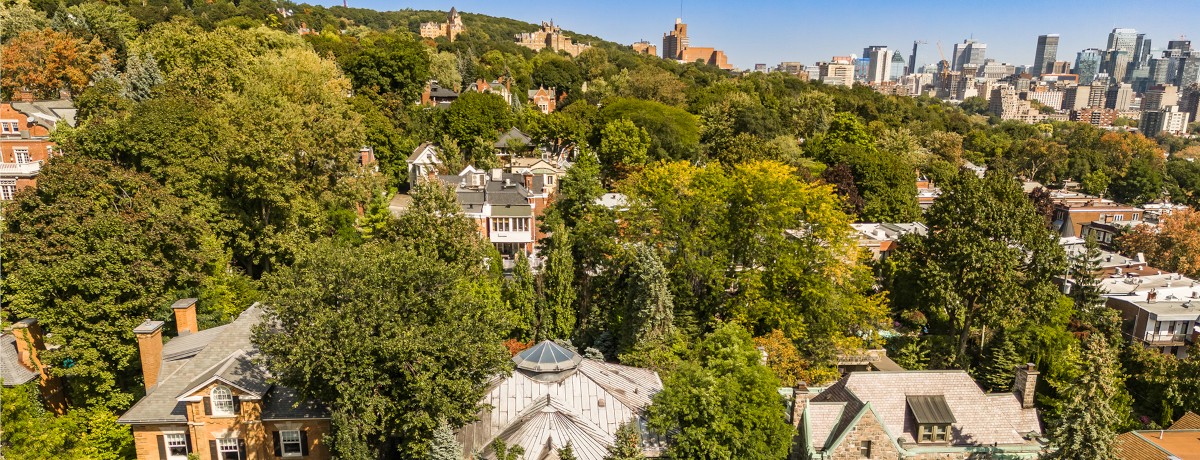
Westmount has a reputation that is easy to recognize. Tree-lined streets, historic homes, mature landscaping, quiet residential blocks and a strong sense of community have made this independent city on the western side of Mount Royal one of the best-known residential areas in Montreal.
But living in Westmount is about more than attractive architecture and a prestigious address.
The city offers a distinctive combination of urban convenience and residential character. Residents are close to downtown Montreal, major transportation routes, shops, restaurants, parks, schools and cultural facilities, while many residential streets have a much quieter atmosphere than the surrounding city.
For buyers considering Westmount real estate, however, there are also important practical considerations. Housing types vary considerably, renovation rules can be more detailed than buyers may expect, and the experience of living in one part of Westmount can be quite different from another.
This guide looks at what it is really like to live in Westmount, the types of properties available, the advantages and disadvantages of the area, and what buyers should understand before purchasing a home.
Where Is Westmount?
Westmount is an independent city located on the western slope of Mount Royal, immediately southwest of central Montreal.
Its position is one of its major advantages. Depending on the exact location, residents can have relatively easy access to downtown, the Atwater and Notre-Dame-de-Grâce areas, Saint-Henri, Montreal’s West Island and major transportation corridors.
Westmount is compact and densely developed. According to the 2021 Census, the city had a population of 19,658 and a population density of 4,861 people per square kilometre.
That density helps explain one of Westmount’s defining characteristics: there is a lot happening within a relatively small geographic area.
What Is It Like to Live in Westmount?
One of the biggest attractions of living in Westmount is the balance between city life and residential surroundings.
You can be relatively close to downtown and major commercial streets without feeling as though you are living in the middle of a high-rise district.
The residential streets are particularly known for:
- Mature trees and landscaping
- Older stone and brick architecture
- Detached and semi-detached houses
- Townhouses and duplexes
- Traditional Montreal-style apartments and condominiums
- Hills and changes in elevation
- Access to parks and green spaces
- A strong neighbourhood identity
Westmount also has a particularly interesting architectural character. Many properties date from the late 19th and early 20th centuries, and the city's planning framework places considerable emphasis on preserving the character of its buildings and neighbourhoods.
That can be a major benefit for people who appreciate historic architecture. It can also affect what you are allowed to change after purchasing a property.
Westmount's Different Residential Environments
One mistake buyers sometimes make is thinking of Westmount as one uniform neighbourhood.
It is not.
The experience can vary considerably depending on the street, elevation, property type and proximity to commercial areas.
Central and Lower Westmount
The areas closer to Sherbrooke Street and the commercial activity around Victoria Avenue tend to offer greater convenience.
This part of Westmount can appeal to buyers who want to walk to shops, restaurants, services, the library and community facilities.
Properties here can include larger apartment buildings, condominiums, duplexes, triplexes and traditional homes.
Upper Westmount
As you move uphill toward Mount Royal, the residential environment becomes quieter and more heavily influenced by detached houses, mature landscaping and larger properties.
The topography becomes more noticeable, with steep streets and staircases in certain areas.
For some buyers, the elevation provides attractive views and a particularly green setting. For others, the hills can be an everyday consideration, particularly in winter.
Around Westmount Park
Westmount Park is one of the city's most important green spaces and contributes significantly to the character of the surrounding area.
The park covers approximately 26 acres and includes sports facilities, playgrounds, a dog run, tennis and pickleball courts, playing fields and other recreational amenities.
For families, people who enjoy outdoor activities and buyers who value access to green space, proximity to Westmount Park can be an important factor when comparing properties.
Housing in Westmount
Westmount real estate is diverse, although single-family homes and traditional residential properties are particularly associated with the area.
Depending on the street and budget, buyers may encounter:
- Detached houses
- Semi-detached houses
- Townhouses
- Duplexes and triplexes
- Condominiums
- Apartments in older buildings
- Larger luxury residences
Many homes have features that are increasingly difficult to reproduce in newer construction, such as substantial lots, mature trees, stone façades, large rooms, traditional woodwork, fireplaces, high ceilings and distinctive architectural details.
At the same time, older homes can require more maintenance.
A buyer looking at a century-old Westmount property should consider more than the kitchen and bathrooms. The condition of the roof, masonry, windows, foundation, electrical system, plumbing, heating system and drainage can have a significant impact on long-term ownership costs.
This is one reason a thorough inspection can be particularly valuable when purchasing an older property.
Parks, Recreation and Community Life
Westmount has an unusually strong network of parks and public green spaces for such a compact urban community.
The city currently identifies 12 parks, 22 green spaces and one wooded nature reserve. Its location on the western slope of Mount Royal contributes to the area's mature landscape and distinctive topography.
Westmount also has a network of public staircases connecting streets and providing access to different elevations and viewpoints.
For residents, these features make the neighbourhood particularly attractive for walking, running and outdoor recreation.
Westmount Recreation Centre
The Westmount Recreation Centre provides additional sports and recreation opportunities, including skating, hockey, swimming and other activities.
Access to certain facilities is tied to a Westmount resident Facility Access Card, which is one example of the local services available specifically to residents.
Westmount Public Library and Victoria Hall
Community life is not limited to parks and sports.
The Westmount Public Library has been part of the community since 1899 and provides library services, programs and activities for residents of different ages.
Nearby Victoria Hall serves as a community and cultural centre, hosting events, exhibitions, courses and other activities.
For people looking for a neighbourhood with established community infrastructure rather than simply a collection of residential streets, this is an important part of Westmount's appeal.
Getting Around From Westmount
Westmount offers a relatively central location for people who need access to other parts of Montreal.
The city's location provides access to several major roads and public transportation connections, while metro stations such as Atwater and Vendôme are close to different parts of Westmount.
The exact convenience depends heavily on where you live.
A property that appears close to a metro station on a map may feel quite different in practice if it involves a significant uphill walk.
For buyers who commute without a car, it is worth testing the actual route from the property rather than simply checking the distance online.
For drivers, access to major roads is convenient, but parking availability varies significantly between properties. A detached home with a garage or private driveway presents a very different situation from an older apartment building with limited parking.
Schools and Family Life
Westmount is often considered by families looking for an established residential environment with parks, recreational facilities and access to schools.
The important point for buyers is that school options and eligibility can depend on the specific property, program and school system.
If school access is an important part of your decision, confirm the current eligibility and admission requirements directly with the relevant school or school service centre rather than relying solely on a real estate listing.
Families should also consider practical factors such as walking routes, parks, sports facilities, childcare and commuting time.
A neighbourhood can look ideal on paper while being less convenient for a particular family's daily routine.
Renovating a Home in Westmount
Renovation rules are one of the most important things to understand before buying Westmount real estate.
Westmount has a detailed planning and architectural framework designed in part to preserve the city's architectural and heritage character. Its Site Planning and Architectural Integration Programme divides the territory into 39 character areas and assigns categories to properties that influence the types of interventions that may be permitted.
In practical terms, buying a historic home in Westmount can mean that you have greater architectural character than you would find in a newer development, but also more restrictions on exterior changes.
Projects affecting exterior elements can require municipal review and approval. This can apply to work involving elements such as:
- Windows and doors
- Exterior walls
- Roofing
- Landscaping
- Balconies and stairs
- Additions
- Mechanical equipment visible from outside
- New construction
The City's current guidance states that exterior projects are generally subject to its SPAIP process, although certain restoration and identical replacement work may be excluded.
Westmount's current by-law framework was also updated in recent years, including changes to its permits and certificates by-law and zoning regulations.
A Practical Example
Imagine you purchase a traditional Westmount house with original wood windows.
You might assume that replacing them with modern windows is a straightforward renovation.
That may not be the case.
The City specifically provides guidelines concerning windows and doors, and interventions involving characteristic exterior elements of heritage buildings can be restricted to restoration or modifications intended to return them to their original condition.
Before purchasing a property with renovation plans, determine what work is actually permitted.
Do not assume that because a renovation is common elsewhere in Montreal, it will automatically be permitted in Westmount.
Property Taxes and the Cost of Living
Westmount's location, housing stock and municipal services contribute to a relatively high overall cost of homeownership.
Property taxes should therefore be considered alongside the purchase price.
For 2026, Westmount lists a residential municipal tax rate of $0.6583 per $100 of valuation for residential properties containing five units or fewer, including the special infrastructure tax.
However, comparing properties solely by municipal tax rate can be misleading.
A buyer should consider the actual tax bill for the property, its assessment, school taxes, insurance, utilities, maintenance requirements and potential renovation costs.
An older house with a lower purchase price may ultimately require more maintenance than a newer condominium, while a condominium may have monthly common expenses and potential special assessments.
The right comparison is therefore the total cost of ownership, not simply the asking price.
The Advantages of Living in Westmount
Westmount can be particularly attractive to buyers who value:
A strong residential character
Many streets have mature trees, historic architecture and established landscaping.
Access to green space
The combination of Westmount Park, smaller neighbourhood parks, Summit Woods and the public staircase network provides considerable access to outdoor space.
Urban convenience
Residents are close to downtown Montreal, shopping, restaurants, public transportation and major employment areas.
Established community infrastructure
The library, Victoria Hall, recreation facilities and municipal services contribute to a well-established community environment.
Architectural character
For buyers who appreciate older Montreal architecture, Westmount offers a particularly distinctive collection of homes and buildings.
Potential Disadvantages of Living in Westmount
No neighbourhood is ideal for everyone.
Potential drawbacks include:
- Higher housing costs compared with many Montreal neighbourhoods
- Older homes that can require substantial maintenance
- Renovation restrictions on certain properties
- Hills and steep streets in some areas
- Limited parking for certain properties
- Differences in property taxes and maintenance costs between housing types
- The need to carefully investigate building condition before purchasing
The renovation issue is particularly important.
A buyer who wants to completely modernize the exterior of an older house may find Westmount less flexible than a neighbourhood where architectural controls are less extensive.
On the other hand, a buyer who values architectural preservation may see those same regulations as part of what makes the neighbourhood attractive.
Is Westmount a Good Place to Buy a Home?
Whether Westmount is the right place to buy depends on what you want from your home and your lifestyle.
It may be worth considering if you are looking for:
- An established residential community
- A central Montreal location
- Historic architecture
- Mature trees and green spaces
- Larger homes or lots
- Strong recreational and cultural infrastructure
- Access to downtown without living directly downtown
It may be less suitable if your priorities are primarily:
- New construction
- Minimal maintenance
- Very low property costs
- Maximum renovation flexibility
- A completely flat neighbourhood
- High-density urban living
The best property is not necessarily the most impressive one.
A smaller condominium near the services you use every day may make more sense for one buyer, while a detached house with a garden may be the better fit for another.
What Buyers Should Check Before Purchasing in Westmount
Before making an offer on a Westmount property, take the time to investigate the things that may not be obvious during a showing.
1. Understand the property's renovation potential
If you are planning exterior work, confirm the municipal requirements before assuming the project is possible.
2. Inspect older building components
Pay particular attention to the foundation, roof, masonry, windows, plumbing, electrical system and heating.
3. Check the certificate of location
Make sure additions, garages, pools, fences and other improvements are properly represented and that you understand any restrictions affecting the property.
4. Review the actual property taxes
Do not rely only on an online estimate or a comparison with another house.
5. Test the commute
Walk to the metro or transit stop from the actual property and consider the route in different weather conditions.
6. Visit at different times
A quiet Saturday afternoon does not necessarily represent weekday traffic or evening activity.
7. Consider the total cost of ownership
Include insurance, utilities, maintenance, renovations, taxes and, where applicable, condominium fees.
For buyers who are still comparing different Montreal neighbourhoods, a broader look at the city's residential options can also be useful.
Common Mistakes Buyers Make in Westmount
Assuming every renovation is permitted
Westmount's architectural controls mean that exterior renovation should be investigated before making assumptions.
Focusing only on the interior
A beautifully renovated kitchen does not eliminate the cost of an aging roof, masonry or foundation.
Ignoring the topography
If you are buying on a steep street, walk the route yourself before making a decision.
Comparing properties only by price
Two homes with similar asking prices can have very different taxes, maintenance requirements, lot characteristics and future renovation needs.
Treating Westmount as one market
The difference between a condominium near Sherbrooke Street and a detached home higher on the mountain can be substantial.
Understanding the broader Montreal market is also important when evaluating any individual property.
Frequently Asked Questions About Living in Westmount
Is Westmount part of Montreal?
Westmount is an independent city located within the Montreal metropolitan area. It is surrounded by Montreal but has its own municipal administration and services.
Is Westmount a good neighbourhood for families?
Westmount can be attractive to families because of its parks, recreation facilities, community services and residential environment. Individual school options and eligibility should always be confirmed based on the specific property.
Is Westmount expensive?
Westmount is generally considered one of Montreal's higher-cost residential areas. However, prices vary substantially according to property type, location, size, condition and other characteristics.
Can you renovate a house in Westmount?
Yes, but exterior renovation can be subject to municipal permits, architectural guidelines and review. Buyers planning significant renovations should investigate the rules applying to the specific property before purchasing.
Does Westmount have good access to public transportation?
Westmount benefits from its central location and proximity to several public transportation connections, including nearby metro stations. The practical convenience depends on the exact location of the property.
Is Westmount walkable?
Many parts of Westmount are well suited to walking, particularly around Sherbrooke Street, Victoria Avenue, Westmount Park and nearby commercial areas. The city's hills and staircases mean that walkability can vary considerably from one street to another.
Final Thoughts on Living in Westmount
Westmount has remained distinctive because it offers something that is increasingly difficult to find in a large city: an established residential environment with historic architecture, mature greenery, community facilities and proximity to the centre of Montreal.
For the right buyer, that combination can be extremely appealing.
But buying in Westmount requires looking beyond the appearance of a property. The age and condition of the building, renovation rules, municipal requirements, taxes, parking, topography and long-term maintenance should all be part of the decision.
The neighbourhood also rewards buyers who take the time to explore its different sections. The experience of living near Westmount Park is not identical to living farther uphill, and a condominium close to Sherbrooke Street presents very different considerations from a century-old detached house.
Ultimately, choosing a home in Westmount is about matching the property, location and ownership responsibilities with your actual lifestyle.
If you are comparing Westmount with other Montreal neighbourhoods, understanding those differences before you buy can help you make a much more informed decision.
If you're thinking about buying or selling real estate in Montreal or anywhere in Quebec, I'd be happy to help. Call me at 514-777-1535 or email Christopher@CCMRealty.ca to discuss your real estate goals.